After going over the art of having difficult conversations with many of my clients, a structure started to emerge. As a therapist I’m a big proponent of difficult conversations. In fact, I think that conflict – if handled well – can be an opportunity. An opportunity for what, you say? Well, an opportunity for resolution, improvements, closeness, empowerment. In fact, research shows that people who go through conflict successfully end up feeling closer than people who don’t experience conflict in their relationships. That said, one doesn’t simply walk into a difficult conversation. There is an art to it, one that can be deconstructed into fairly simple steps. Of course, that structure is somewhat flexible as many things cannot be accounted for ahead of time such as include growing defensiveness, a triggering counter-attack along the lines of DARVO (Deny, Attack, Reverse Victim and Offender), or simply being so flustered that one is losing track of the arguments, improvising off-script and maybe not as skillfully as optimal. But, in general, this architecture has merit and can guide you as you put together your thoughts in preparation for a difficult conversation. For the sake of this exercise, let’s assume this is a conversation involving only two people. On we go!
- Start with an apology if you can
That’s counterintuitive, but if you can authentically apologize for something you did, you are creating more egalitarian expectations for your co-argumentator where they’re not anticipating that this conversation will be a one-sided accusation fest.
For instance: “I apologize for not telling you sooner I had a problem about [something you said or did]. By staying silent I allowed this problem to grow to a problematic extent and now it’s a whole thing.” Or “I apologize for losing my temper when we talked last about X, it must have hurt your feelings and I’m sorry.” - State your positive intention for having a difficult conversation
Making a clear statement that your intentions are good and explaining in what ways the potential outcome of this conversation would improve the relationship or the dynamic between the two of you positions your argument squarely in the camp of finding the win-win rather than allowing the other person to reach the misconception that there is necessarily a loser and a winner in an argument.
Examples include: “I’m hoping that discussing ways to better communicate will benefit both of us: I won’t be so vigilant about getting hurt and you won’t have the feeling of walking on eggshells you’ve told me about before.” Another option: “I’m not here to point out what you’re doing wrong, I just want us to feel closer and there is something I need to address before I can feel safe working on our closeness.” - Use empathy or appreciation
This step exemplify to the other person that you’re at least attempting to put yourself in their shoes. Even if you end up making a guess that is inaccurate about their mental or emotional state, the fact that you are trying to empathise will go a long way and might even give the other person an opportunity to clarify how they feel or think. This is a gift: you’re now out of the defensive monosyllabic rhetoric of people who feel an accusation coming.
Here’s something you could say: “I’ve noticed you’ve put a lot of effort into prioritizing my needs and I wanted to let you know I appreciate it.” Or “We’ve argued a lot about this and I recognize that this is coming from a caring place. You wouldn’t fight me on this if you didn’t care!” - No BUT!
It’s very tempting to now use a “but” to articulate the last statement to your main argument/complaint. DON’T!!! It would instantly ruin the good will you have so carefully garnered from following steps 1 through 3. “But” instantly negates whatever precedes it. Try thinking to yourself “I hear you, but…” and notice how the intention and energy of the whole sentence shifts and leads to the other person not feeling heard even though you said you are hearing them. Instead, try using “and.” From a grammatical standpoint, using “and” means that both parts of the sentence are equally weighted, and, ultimately, equally valid. You might not internally believe the other person’s argument to be as valid as yours, but if you’re entering a conversation with this outlook, chances are the other person will feel that your empathy is not genuine and is simply a trick to manipulate them into agreeing with you. Go in with the open-mindedness of recognizing you do not have the full picture of this two-person dynamic and let your choice of words reflect that. Use a phrase such as: “And I wanted to make a comment/request/suggestion to improve things even more.” Or “And there are things you don’t know about how I feel about this.” - State the problem with an “I” statement
I statements are trickier than they sound. Simply going from “you suck” to “I think you suck” is not a proper example of an “I” statement. In an “I” statement you are owning your reactions and feelings and not implying that the other person is the source of your problems and unhappiness. You are the one who has a problem and is unhappy – which is why you’re having this difficult conversation in the first place. So do not make it about what the other is doing wrong.
For instance, instead of saying “you’re making me angry/sad when you do XYZ” switch to an “I” statement by saying “I feel angry/sad when you do XYZ.” This shifts from connoting an outlook in which you think there’s something wrong with the other person doing XYZ – which they clearly will disagree with, otherwise they wouldn’t be doing XYZ – to one in which XYZ is neutral, were it not creating some discomfort or distress for you. - Make a specific request of the other person
This step is crucial. Most people never go from stating their complaint to making a request. The request element allows the conversation to move into its collaborative problem-solving phase. The sky is the limit in terms of what you can request and is entirely dependent on your circumstances and relationship dynamic. However, this exercise might feel like a stretch to you if you have been used to complaining about what’s wrong without thinking about what could make things right.
Examples of requests include: “Would you mind waiting until I’m out of the house to do XYZ?” But also “Would it be possible for you to give me some positive feedback after you give me some constructive criticism?” “How would you feel about actually putting things in the calendar when we talk about getting together so that I can feel like you are prioritizing me?” “Would you be able to use my chosen name instead of my dead name/a nickname?” - How to handle defensiveness
This is a ninja trick that takes nerves of steel to master, but will yield astounding results. If the other person gets defensive and you understand where they’re coming from, articulate their point of view in your own words, they will feel heard and understood and this should really take the activation down a notch for both of you. Try telling them “You don’t feel that it’s fair of me to make this request” even if you – probably – feel that you have every right. Another option if you’re not quite sure you understand their position is “I can see I’ve struck a nerve. Can you tell me what you heard me say?” With either strategy, you are inviting a deeper understanding of the other person and their outlook. This might not lead to the reciprocal move of them understanding your position, but without this step, everyone digs their heels in and no collaborative progress can be achieved. Once they feel heard, it could be that your request will shift naturally to accommodate their perspective. This, in essence, is how one finds a true win-win. - Use empathy or appreciation again
In the classic technique known as the “appreciation sandwich” you are going to bookend the conversation with another slice of empathy or appreciation. Let it be genuine! Try: “I appreciate you for listening to me and taking my request seriously.” Also possible: “Thank you for your open-mindedness and courage. I know this conversation was hard for you and it means the world to me that you were willing to have it.”
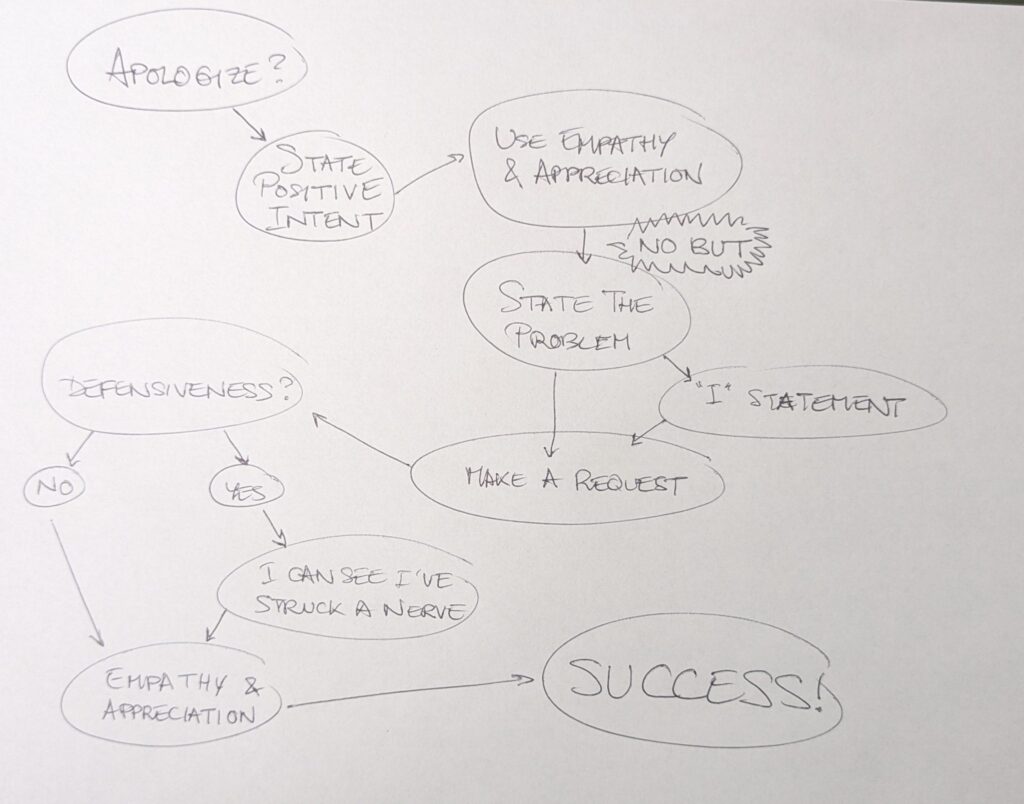
And that’s it! It’s simple but not necessarily easy. If remaining calm is a concern for you ahead of the conversation I recommend using some stress management strategies can help lower your baseline so you don’t go in already nervous! Also working through the steps of this conversation template with your therapist – or with a very safe and emotionally intelligent friend – is always great. But most of all write your ideal dialogue down beforehand: it will allow you to find your way back should you get sidetracked and lose sight of your goals. Good luck!